
Most CIOs will never say it out loud.
Not in the boardroom.
Not during steering committee meetings.
Not while presenting a polished business case to the executive leadership team.
But underneath almost every major technology initiative is the same quiet fear:
“What if this decision goes horribly wrong?”
Because CIOs know something most organizations underestimate.
Enterprise technology projects rarely fail because the software simply “didn’t work.”
They fail because the organization selected the wrong vendor, underestimated implementation complexity, trusted vague vendor promises, overlooked third party technology risk, or rushed a decision that could not safely or inexpensively be undone.
And when it happens, the fallout is rarely contained to IT.
It spills into operations.
Finance.
Customer experience.
Employee morale.
Executive trust.
Board scrutiny.
Reputations.
Careers.
For CIOs navigating AI disruption, cybersecurity threats, economic uncertainty, increasing regulatory pressure, and relentless pressure to modernize faster with fewer resources, the stakes have never been higher.
This is no longer just about buying software.
It is about CIO technology risk management, operational resilience, and protecting the business from catastrophic vendor selection mistakes.
Why SaaS Vendor Selection Risks Are Escalating for Canadian CIOs
Today’s CIO is expected to be simultaneously:
A technology strategist
A cybersecurity leader
An operational risk manager
A transformation executive
A cost reduction expert
An innovation driver
An AI governance advisor
A third party technology risk expert
All while trying to keep critical business operations stable.
Meanwhile, enterprise software ecosystems have become dramatically more dangerous to navigate.
Modern SaaS and enterprise vendors now introduce hidden complexity most organizations never fully uncover during the sales cycle:
AI and machine learning clauses buried in contracts
Cross border data transfer exposure
Escalating subscription pricing
Vendor lock in models
Complex implementation dependencies
Hidden subcontractor ecosystems
Online policies vendors can quietly modify without you even knowing
What looks polished during a vendor demo often becomes operational chaos after Go Live.
And deep down, many CIOs know it.
Because what they are really thinking is:
“If this fails, everyone will remember who approved it.”
The Cost of IT Project Failure Is Massive
Research continues to show that enterprise technology and digital transformation initiatives fail at alarming rates.
McKinsey research on digital transformation failure rates found that large scale transformation initiatives frequently fail to achieve intended outcomes due to poor alignment, inadequate change management, weak governance, and unrealistic implementation expectations.
Similarly, Gartner research on ERP implementation failure risk continues to emphasize that ERP implementation failure risks often stem from poor requirements definition, lack of stakeholder alignment, weak vendor evaluation methodologies, and underestimated operational complexity.
The reality is uncomfortable:
Many IT project failure causes begin long before implementation starts.
They begin during vendor selection. Following are real fears CIO’s face everyday when preparing to select a third-party vendor solution.
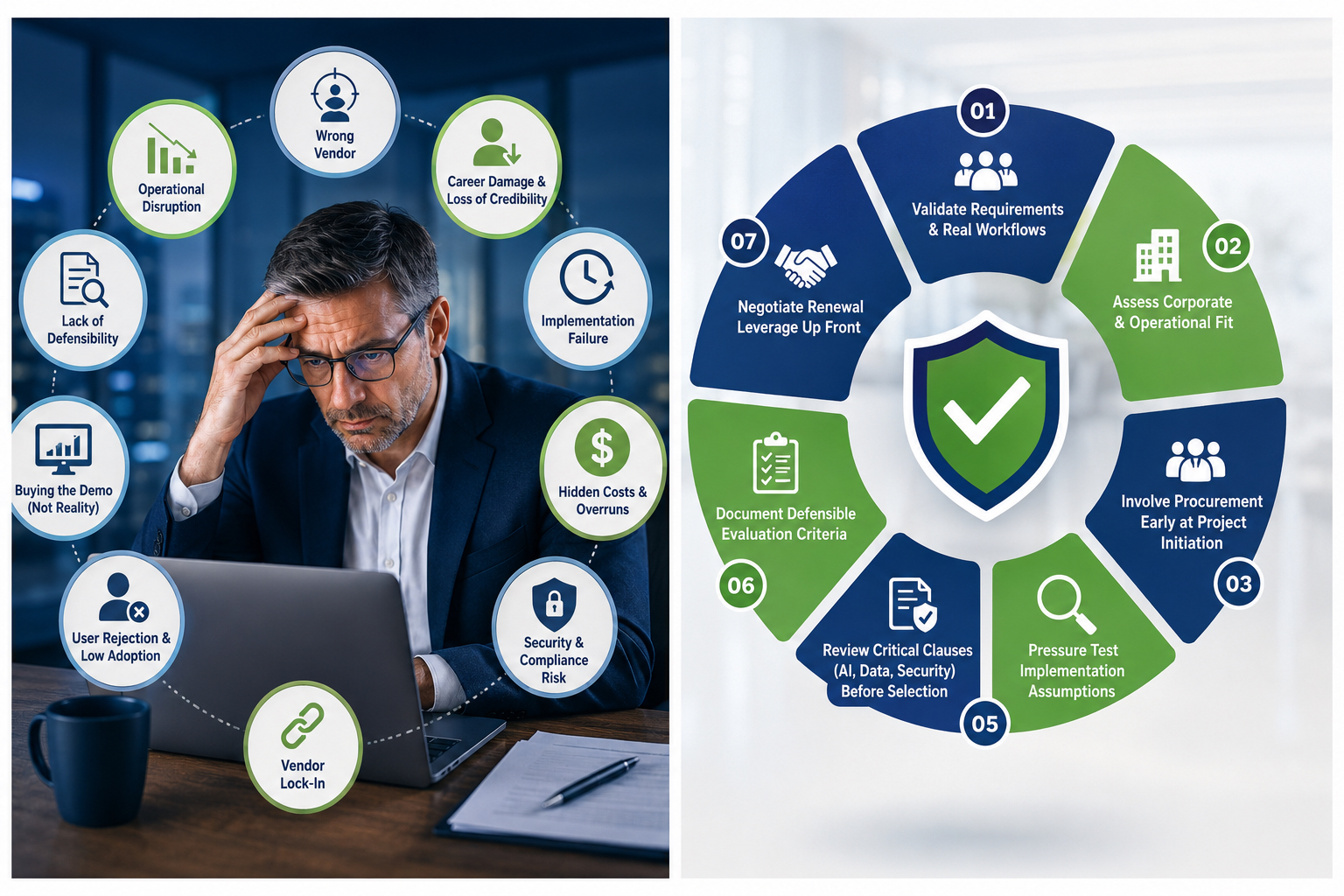
The 10 Hidden CIO Vendor Selection Fears Nobody Talks About
1. Choosing the Wrong Vendor
Every CIO has seen it happen.
The demos looked polished.
The references sounded strong.
The vendor said all the right things.
Then implementation begins and reality hits.
The workflows do not actually fit the business requirements
The integrations become far more complicated than expected
The vendor’s implementation team lacks depth and are juggling multiple competing client implementations
The promised timelines collapse and resources start to fatigue
What most CIOs are not saying out loud is:
“What if I signed off on the wrong platform?”
Because selecting the wrong vendor does not just create technical problems.
It creates organizational trauma.
The catastrophic outcomes can include:
Failed implementation
Massive rework
Executive blame
Multi year operational pain
Full replacement project within a few years
2. Implementation Failure
Many CIOs carry the quiet fear that the project itself will spiral publicly out of control.
What CIOs are really thinking is:
“What if this project becomes a public internal failure?”
When implementations fail, everyone feels it.
Employees become frustrated.
Business leaders lose confidence.
Executives escalate concerns.
Customers may even experience disruption.
The catastrophic outcomes can include:
Delayed go live dates
Budget overruns
Operational instability
Staff frustration
Executive escalation
Business disruption
And once a project gains a reputation internally as “the disaster project,” that reputation can follow leadership for years.
3. Hidden Costs & Budget Overruns
Most enterprise software projects never cost what organizations initially approve.
The real costs often appear after contracts are signed.
What many CIOs are privately thinking is:
“The actual cost was double what we approved.”
The surprises quietly begin stacking up:
Consulting overages
Integration complexity
Additional licensing
Data migration issues
AI feature premiums
Change orders
Extended implementation timelines
Then finance starts asking questions.
“Why was this missed?”
“Did we fully assess the vendor?”
“Did we negotiate properly?”
At that point, the conversation is no longer about technology.
It becomes about accountability.
4. Security or Compliance Failure
This fear has intensified dramatically with AI, cloud ecosystems, and evolving privacy regulations.
What CIOs are silently thinking is:
“What if we approved a vendor that exposed the company?”
Many SaaS vendors now include contractual language allowing them to:
Use customer data to train AI models
Aggregate operational data
Transfer information across borders and jurisdictions
Modify online data policies without negotiation or even awareness
The catastrophic outcomes can include:
Data breaches
Regulatory investigations and fines
Financial penalties
Customer trust erosion
Board level scrutiny
Canadian organizations are facing increasing pressure around cybersecurity governance, data residency, and third party technology risk management.
The OSFI B-10 Third Party Risk Management Guideline significantly raises expectations around operational resilience, subcontractor oversight, governance accountability, and vendor oversight.
5. Vendor Lock In
Many organizations discover too late that modern SaaS ecosystems are intentionally difficult to exit.
Renewal costs escalate.
Migration becomes expensive.
Negotiating leverage disappears.
And suddenly the organization feels trapped.
What many CIOs are really thinking is:
“We can’t get out of this without enormous cost.”
The catastrophic outcomes can include:
Escalating renewal pricing
Inability to exit
Reduced negotiating leverage
Technology stagnation
Long term operational dependency
The wrong SaaS vendor selection decision can constrain an organization for years if not decades.
6. Stakeholder Revolt & User Rejection
Many technology projects fail socially before they fail technically.
The software technically works.
But employees hate it.
What CIOs are worried about is:
“What if everyone rejects the system we selected?”
Then the workarounds begin.
Spreadsheets return.
Shadow IT systems emerge.
User adoption drops.
Internal political conflict and finger pointing escalates.
The catastrophic outcomes can include:
Low to no adoption
Shadow IT systems amplifying risk
Manual workarounds multiplying errors
Productivity declines increasing costs
Internal political conflict
A technically successful implementation can still become an organizational failure.
7. Buying the Demo Instead of Reality
Most vendor demos are theatre.
The workflows are polished.
The scenarios are curated.
The complexity is hidden.
What CIOs are really worried about is:
“What if we bought the sales presentation instead of the real solution?”
Then reality arrives after Go Live.
Critical functionality you thought was there is missing.
Processes require manual workarounds.
Reporting does not meet expectations.
Customization becomes expensive.
In a recent engagement my Canadian mid market client selected an ERP platform largely based on demo capabilities and aggressive implementation timelines.
Six months into deployment, despite vendor assurances, the Payroll module could not accommodate US payroll and did not integrate properly with the HR module.
Shiny demos and vague vendor promises delayed their US expansion plans by years and created operational disruption and loss of confidence across finance, payroll, and employees.
The catastrophic outcomes were real and included:
Delayed US expansion
Missing functionality
Process inefficiency
Manual workarounds
Failed business outcomes
Loss of employee trust
Failed business outcomes
Rip and replacement of systems
Thousands of dollars lost and valuable time wasted
This is exactly why mature software selection governance is so critical. Unfortunately, we were brought after the catastrophic failures to help select the right solution by gathering comprehensive requirements, supplier market research and managing the supplier evaluation and selection process. I only wish they had called us first before catastrophic failures emerged.
8. Lack of Executive Defensibility
This is one of the deepest hidden fears CIOs carry.
“What if we cannot defend this decision later?”
Because when projects struggle, investigations begin.
CEOs ask questions.
Boards ask questions.
Auditors ask questions.
Legal asks questions.
And if the selection process lacks governance, documentation, evaluation frameworks, or risk assessments, the CIO often becomes the focal point of scrutiny.
The catastrophic outcomes can include:
Procurement decisions challenged
Audit scrutiny
Executive conflict
Finger pointing
Reputation damage
This is why executive defensibility is not optional anymore.
It is protection.
9. Operational Disruption
This is where fear becomes operational reality.
What CIOs are truly afraid of is:
“What if the business stops functioning properly?”
When enterprise systems fail, the impact spreads fast.
Customer experience suffers.
Orders stop flowing.
Invoices fail.
Payroll gets disrupted.
Revenue gets impacted.
The catastrophic outcomes can include:
Downtime
Customer impact
Payroll failures
Supply chain disruption
Revenue loss
Operational chaos
These are the moments executives remember for years.
10. Career Damage & Loss of Credibility
This is often the deepest emotional driver behind every major technology decision.
Not the software.
Not the contract.
Not even the implementation.
The real fear is personal.
“What if this damages my credibility?”
Because failed technology initiatives can trigger:
Loss of executive confidence
Reduced influence
Reputation damage
Career stagnation
In severe situations, job loss
Most CIOs are not simply protecting technology operations.
They are protecting years of professional credibility and leadership trust.
How Can CIOs Reduce Technology Vendor Risk?
The good news is that many vendor selection risks are preventable with the right governance, methodology, and procurement discipline.
High performing organizations do not rely on vendor demos, assumptions, or informal decision making processes.
They implement structured, defensible vendor evaluation frameworks designed to reduce operational, financial, security, and implementation risk before contracts are signed.
To reduce vendor selection risks and improve CIO technology risk management, organizations should:
Validate requirements and real workflows early – Ensure business requirements reflect actual operational processes, integrations, reporting needs, compliance obligations, and future scalability requirements.
Assess corporate and operational fit – Evaluate whether the vendor’s implementation methodology, support model, culture, roadmap, and operational maturity align with your organization.
Involve procurement expertise early at project initiation – Procurement should not appear at the contract stage. Early involvement improves governance, vendor evaluation consistency, negotiation leverage, and third-party technology risk assessment.
Pressure test implementation assumptions and methodology – Challenge timelines, staffing assumptions, dependencies, integration complexity, and change management requirements aggressively before selection.
Review critical clauses like AI and data protection extensively before selection – Assess data ownership, AI training rights, data residency, sub processor dependency, subcontractor usage, termination rights, cybersecurity obligations, and pricing escalation language early.
Document defensible evaluation criteria – Maintain clear evaluation methodologies, governance and decision approvals, evaluation documentation, and risk assessments to strengthen executive defensibility.
Negotiate renewal leverage up front – Most organizations focus heavily on recurring and one-time implementation costs while ignoring long term renewal leverage, exit flexibility, and future pricing protections.
Organizations that approach software selection as an executive risk management exercise consistently make stronger, safer technology decisions.
What Mature Vendor Selection Looks Like
High performing organizations typically:
Document and validate requirements and real workflows
Assess corporate and operational fit and fitness
Involve procurement expertise early at project initiation
Pressure test implementation assumptions and methodology
Review critical clauses like AI and data protection extensively before selection
Document defensible evaluation criteria
Negotiate renewal leverage up front
Mature vendor selection processes are structured, evidence based, cross functional, and highly defensible.
They focus not just on functionality and pricing, but on long term operational success, governance, resilience, and risk reduction.
This is where organizations dramatically reduce IT project failure causes and improve long term technology outcomes.
Why CIOs Need Protection, Not Just Procurement
This is where many organizations get it wrong.
They approach vendor selection as a sourcing exercise.
But modern enterprise software and IT procurement is fundamentally a risk management exercise.
At ProcurePro Consulting, we help CIOs reduce vendor selection risk long before contracts are signed and implementation begins.
Our role is not simply helping organizations buy software, infrastructure, professional or managed services.
Our role is helping protect your business and the executive team behind the decision.
We help organizations implement:
Structured vendor evaluation frameworks
Risk based procurement governance
Commercial negotiation strategies
Contract and AI clause reviews
Vendor risk assessments
Stakeholder alignment
Executive defensibility documentation
Operational risk identification
Because flashy demos do not reduce risk.
Structured governance does.
Because hope is not a strategy.
Defensible procurement and vendor selection expertise is.
Related resources for you to explore:
Most technology project failures begin long before implementation starts.
They begin during vendor selection.
That’s where organizations unknowingly expose themselves to:
Unclear requirements
Inconsistent evaluations
Hidden implementation risks
Security and compliance gaps
Stakeholder misalignment
Vendors that look good in demos but fail operationally later
By the time the problems become visible, contracts are signed and fixing the damage becomes far more expensive.
Many CIOs don’t realize how exposed the organization is until:
Budgets start slipping
Timelines fall behind
Users reject the system
Operational disruption increases
Leadership starts questioning the decision
Before You Issue Your Next RFP
Before issuing your next RFP, assess whether your organization is truly prepared.
ProcurePro’s free RFP Readiness Diagnostic helps identify hidden gaps before they become expensive business problems.
✔ Less than 10 minutes
✔ Immediate results
✔ Designed for CIOs and IT Leaders
Take the assessment: https://zfrmz.com/C065zC7ZtpPrEDdlSFlw
Final Thought
Most catastrophic technology failures do not begin during implementation.
They begin much earlier.
During vendor selection.
During rushed evaluations.
During weak governance.
During moments when organizations underestimate risk because the demos looked impressive.
And what most CIOs are not saying out loud is this:
“This decision could impact my reputation for years.”
That is why vendor selection today is no longer simply a technology exercise.
It is an executive risk management decision.
If your organization is preparing for a major IT project, ERP initiative, SaaS procurement, IT transformation or modernization project, or technology renewal, now is the time to pressure test the process before contracts are signed.
Ready to reduce vendor selection risk?
Connect with me at ProcurePro Consulting to identify hidden risks, strengthen executive defensibility, and protect your organization before your next major technology decision.